Guest loyalty in tourism: how your routes become a reason to come back
 By Philipp Avenell ·
·
6 min read
You have the most beautiful routes. But do you know who's using them? Most destinations invest heavily in hiking trails, cycle routes and tour portals. The routes are there, well signposted and beautifully photographed. What's missing is a reason to do them a second and a third time. And knowing who does. In this article, we show how destinations turn existing routes into a collection format that keeps guests coming back for a whole season, while showing you who your most active guests are.
Why beautiful routes alone don't create regulars
A route suggestion is an inspiration product. It works in the phase when guests are planning their day out or their holiday. Once someone has done the tour, they tick it off. The customer journey ends with the visit, and the next trip starts from scratch, often in a different region.
Guest loyalty works differently. It needs a goal that goes beyond a single day. Anyone who has collected three of seven summits wants the other four. Anyone who has ridden two passes plans the third. This is exactly the mechanism most tour portals lack: they show what's possible, but they don't give people a reason to come back.
What you already measure, and what's missing
Most destinations already measure quite a lot. Counters on trails, statistics from tour portals, heatmaps from sports apps, website traffic. That's valuable data, and it would be wrong to claim you know nothing about your guests.
But this data has two limits:
- It's anonymous. You know that 400 people passed the signpost on a Sunday. You don't know which of them were there for the third time, where they come from or whether they read your newsletter.
- It doesn't build a relationship. You can't write to a number on a dashboard. You can write to a guest who has signed up for your challenge and agreed to receive your newsletter.
So the difference isn't between "measuring" and "not measuring". It's between anonymous reach and guests you can actually reach.
From route suggestion to collection format
A collection format turns your existing routes into a season-long challenge. The principle is simple and needs no new infrastructure:
- Choose your checkpoints. Pick six to twelve places from your existing tours: summits, passes, viewpoints, huts, lakes. What matters is the place, not the distance. A place is a goal, a kilometre is just a number.
- Define levels. Intermediate goals keep motivation high, for example at 3, 5 and all checkpoints. Each level unlocks a badge and a reward.
- Anchor rewards in the region. The certificate is collected at the tourist office, the voucher is valid at a partner business, the finisher's gift is picked up locally. That way, the format brings guests not only up the mountain, but also to your partner businesses.
- Make check-ins effortless. Guests confirm a checkpoint automatically via their sports watch or sports app (Garmin, Polar, Strava), or on site via QR code or browser check-in, with no app download.
At LaceUp, this format is called Trophy. It runs entirely in your own branding: your domain, your design, your registration. LaceUp stays in the background.
What you learn about your guests
A collection format is a guest loyalty tool and a data source at the same time. Because participants register with you, you build first-party data: data you collect directly from your guests, with their consent.
After one season, you'll know, for example:
- how many participants weren't in your database before,
- where they come from (postcode, country),
- how often they came back and in which months,
- which checkpoints work and which are hardly visited,
- who opted in to a newsletter or partner offers.
It's worth being honest about what this means: you're not measuring all your guests, only the participants. These are your most active guests, who have made a conscious choice to take part in your format. And this is exactly the group that's most valuable for repeat visits and recommendations.
Two examples from practice
Alpenbrevet Extended: seven passes, one whole season
The Alpenbrevet is a cycling marathon over the passes around Andermatt that has been selling out fast for years. With Alpenbrevet Extended, cyclists can ride the seven passes from May to October, whenever and as often as they like. Each pass earns a badge, and a leaderboard and prizes keep motivation high.
Around 2'000 participants take part each year. Around 65% of them had never been to the physical event. And around 40% combine their participation with an overnight stay. For the destination of Andermatt, the format is therefore not a by-product of an event, but a communication channel across the entire summer season.
7 Hills Challenge: seven summits around Lake Zurich
The 7 Hills Challenge shows that the principle works without passes or road bikes too. From May to October, hikers collect six summits around Lake Zurich and a bonus summit in Graubünden. Each summit is confirmed automatically via Strava or Garmin, or by scanning the QR code on the signpost at the top. There are rewards at 2, 3, 5 and 7 summits, and anyone who completes all seven becomes a "Hill Legend" and earns a place on the Wall of Fame. The presenting partner is Zürcher Wanderwege (the Zurich hiking trail association). Around 1'000 people took part.
How to get started in three steps
- Review what you already have. Which routes and places do you already feature in your tour portal, on your website or in brochures? Usually, the material for a collection format is already there.
- Start small. A pilot with up to five checkpoints is enough to learn how your guests respond. A full season with up to twelve checkpoints, badges and automated emails is the next step.
- Plan your communication. Every checkpoint, every level and every new name on the Wall of Fame is a hook for your newsletter, social media and media relations. That gives you months of content instead of a single campaign peak.
It takes around six weeks from idea to launch. LaceUp takes care of the concept, design, operation and participant support.
Frequently asked questions
Do guests need an app? No. Participants either connect the sports watch or sports app they already use, or they confirm checkpoints on site via QR code or browser link. They register with you, not with a platform.
Who owns the data? The activity data belongs to the participants. You receive a time-limited, purpose-bound right to use results and contact data, and you obtain marketing consent directly at registration. The data is stored with an ISO 27001-certified hosting provider in Germany, and a data processing agreement (DPA) is standard.
Is this worthwhile for small destinations too? Yes, especially for them. A collection format needs no infrastructure, and just five well-chosen places are enough for a first season.
How much does a collection format cost? A pilot with up to five checkpoints costs CHF 5'000 per season, a full season with up to twelve checkpoints CHF 9'200. With a three-year agreement, prices drop by 20%. There are no per-participant fees.
Conclusion
Guest loyalty in tourism doesn't start with new routes, but with a reason to experience the existing ones once more. A collection format provides that reason and, along the way, shows you who your most active guests are. With contact details, with consent and in your own branding.
Want to see what this could look like for your region? Request our documents, including a concept example, references and transparent pricing. No obligation, no meeting required.
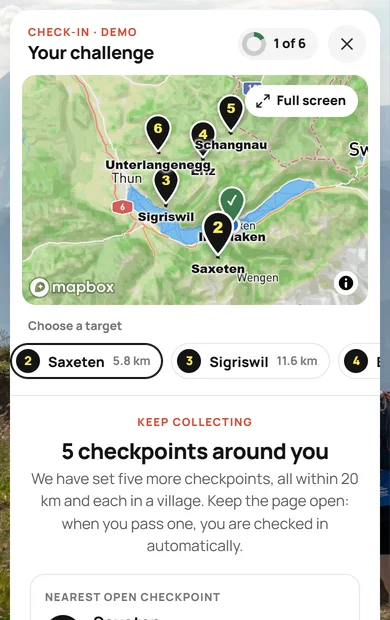
Live demo
Try the check-in yourself
We set a checkpoint exactly where you are standing, and five more in villages around you. This is how participants experience a Trophy: no app, just their phone.
- Share your location
- Collect the checkpoint
- Five more around you

Map image © Mapbox © OpenStreetMap