Visitor management in tourism destinations: spreading guests with incentives, not bans
 By Philipp Avenell ·
·
5 min read

Visitor management is on the agenda of almost every destination. At well-known viewpoints, lakes and old towns, infrastructure and local acceptance are reaching their limits, while side valleys and smaller places hardly benefit. Most measures rely on information or restriction. A third lever is rarely used: incentives. This article shows how collection formats spread guests across places and across the year, without bans and without wagging fingers.
Why visitor management is so difficult
In 2025, the Swiss hotel industry set a record with around 43.9 million overnight stays, and for the first time more than 25 million were counted in summer. But the growth is unevenly distributed. An analysis by the NZZ am Sonntag (a leading Swiss Sunday newspaper) in summer 2026 showed that the 50 largest destinations gained around 1.7 million overnight stays compared with 2023, an increase of more than 6%. The roughly 130 smaller destinations grew by less than 2% over the same period. According to the analysis, the spread across the year has hardly changed either. Switzerland Tourism considers it too early for a final verdict, because travel habits only change slowly.
This shows how persistent visitor flows are. Guests go where others have already been, and where images on social media lead them. If you want to steer them elsewhere, you have to give them a good reason to go somewhere else.
Three levers of visitor management
| Lever | Examples | Effect |
|---|---|---|
| Restriction | quotas, reservations, parking charges, closures | effective, but unpopular and politically sensitive |
| Information | real-time occupancy, alternatives on the website, signage | important, but only reaches those actively looking |
| Incentive | bonus points, rewards, goals unlocked over time | experienced positively, still rarely used in tourism |
All three levers have their place. Restriction and information tell guests where not to go, or where it's quiet right now. An incentive makes the quieter place the actual destination.
Five ways collection formats steer guests
1. The choice of checkpoints
Whatever is on the collection map gets visited. That sounds obvious, but it's the strongest lever. In the 26 Summits hiking challenge, for example, the most popular route in 2024 wasn't one of the well-known hotspots in the Alps, but the Geissfluegrat ridge in the canton of Aargau, with 726 ascents. Easily accessible, lesser-known places can become real destinations through a collection format.
2. Bonus points for quiet places and times
A checkpoint in a side valley counts double, a visit on a weekday earns a bonus, and anyone who comes in October receives an extra badge. Guests remain free to choose, but the quieter option becomes more attractive.
3. Time windows that unlock checkpoints gradually
Instead of opening all destinations from day one, they are unlocked in stages. In the Züri Velo Cup Winter Quest, for example, participants collected nine municipalities around Zurich, with three new ones unlocked each month, from 21 December to 21 March. That spreads participation across the whole season instead of the first few weekends.
4. A season instead of a single day
A single event day concentrates thousands of people on one date. A season spreads them out. At Alpenbrevet Extended, around 2'000 participants ride the seven passes around Andermatt between May and October, whenever they like. That's visitor management over time, and it extends the season into the quieter months.
5. Rewards in the right place
Where a reward is collected helps decide where guests go. A certificate at the tourist office of a smaller village, a voucher at an inn in a side valley, or a bonus checkpoint in a partner region, like the bonus summit in Graubünden at the 7 Hills Challenge, steer visits to where they are welcome.
What you can measure, and what you can't
A collection format shows you how participants are spread across places and months, and whether bonus points or time windows change that spread. So you can test which incentive works and adjust the format for the next season.
What it doesn't show is the distribution of all guests. It measures participants, not every person on the hiking trail. For the overall picture, counters, overnight stays and mobility data remain the right basis. A collection format adds a group you can reach and deliberately steer.
For cities, cantons and municipalities
Visitor management isn't just an issue for mountain destinations. Cities want to draw visitors out of the old town into other neighbourhoods, cantons want to promote physical activity while easing pressure on local recreation areas, and municipalities want to make their own destinations for day trips more visible. A collection format brings these goals together: neighbourhoods, observation towers, fountains or forest clearings become checkpoints, participation is possible without an app, and schools, families and clubs can join in. Our article Challenge without an app explains how recording works for a broad audience.
Frequently asked questions
Does a collection format replace traditional visitor management measures? No. It adds a positive incentive to information and restriction. It works best in combination: real-time information for the moment, a collection format for planning the next day out.
How big does the effect have to be for it to be worthwhile? That depends on the goal. Even a shift within the group of participants shows which incentives work. That insight can be applied to other communication measures.
Does every checkpoint need a sign? No. Checkpoints can be confirmed via GPS recording or browser check-in. Signs with a QR code are an option, not a requirement.
How many participants do you need for a format to be worthwhile? There's no minimum number and no per-participant fees. A pilot with up to five checkpoints costs CHF 5'000 per season.
Conclusion
Visitor management doesn't have to rely only on bans and notices. A collection format turns quiet places into destinations, spreads visits across the season and shows which incentive works. For guests, it doesn't feel like being managed, but like discovering something new.
Looking for new approaches to visitor management in your region? Request our documents, including a concept example, references and pricing. No obligation, no meeting required.
Live demo
Try the check-in yourself
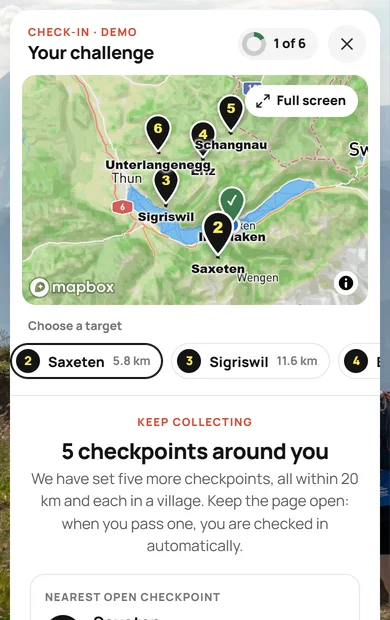
We set a checkpoint exactly where you are standing, and five more in villages around you. This is how participants experience a Trophy: no app, just their phone.
- Share your location
- Collect the checkpoint
- Five more around you

Map image © Mapbox © OpenStreetMap