Ski resort gamification: collecting slopes instead of counting lifts
 By Philipp Avenell ·
·
6 min read
Ski resorts measure a lot: skier visits, lift rides, vertical metres. But the access system knows the lift, not the slope. This is where one of the simplest forms of ski resort gamification comes in: collecting slopes. A season goal that brings regulars back more often, livens up lesser-known sectors and shows you who your most loyal guests are. Without your own app and without new infrastructure on the mountain.
Why ski resort gamification often stops at the daily recap
Many ski resorts now offer a digital daily recap: vertical metres skied, number of lift rides, sometimes photos or speed measurements. It's a nice experience in the evening after a day on the slopes. But little of it lasts for the season, because a recap doesn't set a goal. Someone who skied 8'000 vertical metres today has no reason to come back tomorrow, apart from the snow.
At the same time, the season is short and depends on the weather. According to Seilbahnen Schweiz (Swiss Cable Cars), skier visits in winter 2025/26 were around 2% below the record winter before, but 13% above the five-year average. The start was weak due to a lack of snow until mid-December, while the spring was strong. Every extra day your regulars spend on the slopes therefore counts double.
The gap: the turnstile knows the lift, never the slope
A lift usually serves several runs. The access system can't know which one was chosen, because it only measures at the turnstile. For gamification, this matters, because slopes have what lifts don't: a name, a colour and a reputation. The black run, the run down to the valley, the World Cup course. That's what guests talk about, not the chairlift.
The only way to record runs precisely is with GPS. That sounds like a lot of effort, but for many guests it isn't: anyone who already records their ski days with a sports watch or smartphone doesn't have to learn anything new.
Collecting slopes: the simplest season goal
The principle is quickly explained:
- Every slope is a checkpoint. Ski it once and it's in your collection.
- Complete whole sectors. Anyone who has collected every run in a sector earns a badge. Along the way, this nudges guests into corners of the ski area they would otherwise skip.
- Levels across the season. For example at 10, 25 and all slopes, with rewards redeemed in the ski resort: a coffee at the mountain restaurant, a discount at the sports shop, a day pass for a companion.
- Wall of Fame. Anyone who completes every slope makes the list. For ambitious regulars, that's a strong reason to head up the mountain for an extra day.
The difference from a daily recap: the format sets a goal for the entire season. Every new slope is progress, every level is an occasion for a personal message, and every empty spot on the collection map is a reason for the next visit.
A variant for iconic runs: who skis it most often?
Some ski resorts have a slope with a history, such as a World Cup or race course. For these, a second mechanic works well, the Effort Counter: what counts is not who skis it fastest, but who skis it most often. On an open slope this is also the better choice for safety reasons, because timing people during normal slope operation is not a good idea. Levels at 1, 5 and 10 runs, a hidden badge for the record number and a leaderboard turn the slope into a legend you have to earn.
A division of labour, not a second ski app
Many ski resorts already work with an app for the daily recap. A collection format doesn't replace it, it complements it:
| Daily recap via the access system | Collection format with LaceUp | |
|---|---|---|
| Records | lift rides, vertical metres, entries | slopes, sectors, repeat runs |
| Time horizon | one ski day | the whole season |
| Motivation | looking back | a goal |
| Contact | with the provider or with you, depending on the solution | with you, with consent |
| Participation | via the respective app | via sports watch, smartphone recording or QR code at landmark spots, with no app download |
Another advantage: the format doesn't stop at company boundaries. Several mountain railways in a region can offer a joint collection format, even if their access systems are separate. And in summer, the same participant base can be activated again with summits, huts or bike trails.
What a collection format is not
Being honest also means saying what a collection format isn't meant to do. It's not a data source for slope management. The GPS data comes from participants who have consciously signed up. That's a valuable group, but not a representative count of all guests. For snowmaking or grooming, your existing systems remain the right basis.
And in winter, recording is more demanding than in summer. Cold fingers and gloves make QR scanning awkward. That's why we only use QR codes at a few landmark spots, such as the top station, and leave the slopes to GPS recording.
Frequently asked questions
Is GPS in a ski resort accurate enough to tell slopes apart? Slopes are defined as zones, and the tolerance can be set for each format. Where two slopes run very close together, a distinctive section is chosen as the checkpoint. In addition, an algorithm developed with ETH Zürich checks the recordings for irregularities.
Do guests need a sports watch? No. Recording with a smartphone is enough. Anyone who doesn't want to record anything at all can check in at landmark spots via QR code or browser link.
Does this compete with our existing ski app? No. The daily recap stays where it is. The collection format sets a season goal and runs in your own branding. You can promote both side by side.
When do we need to start to be ready for next season? With around six weeks' lead time, a format is ready to go. If you want to launch at the start of the season in December, you need to decide by the end of October. A format for the second half of the season, for example from the Sportferien (the Swiss school winter sports holidays) until Easter, can still be set up during the winter.
Conclusion
Ski resort gamification doesn't have to be complicated. Slopes have names, colours and stories, and collecting them is a goal everyone understands straight away. A collection format brings regulars back more often, livens up quieter sectors and creates a direct line to your most loyal guests, across the whole season and in your own branding.
What would your ski resort look like as a collection map? Request our documents, including a concept example, references and pricing. No obligation, no meeting required.
Live demo
Try the check-in yourself
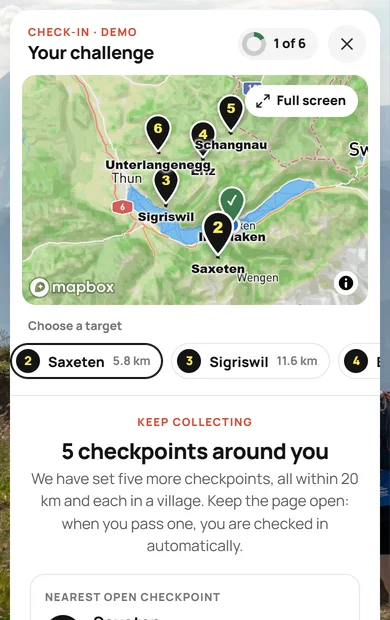
We set a checkpoint exactly where you are standing, and five more in villages around you. This is how participants experience a Trophy: no app, just their phone.
- Share your location
- Collect the checkpoint
- Five more around you

Map image © Mapbox © OpenStreetMap